AI Music Genre Catalog: 87 Style Descriptors That Work in Suno
Naming the genre precisely shapes the tone. A catalog of 87 genre, sub-genre, instrument, and mood descriptors that actually resolve well in Suno.
A genre name sets tone, instrumentation, and BPM in one move
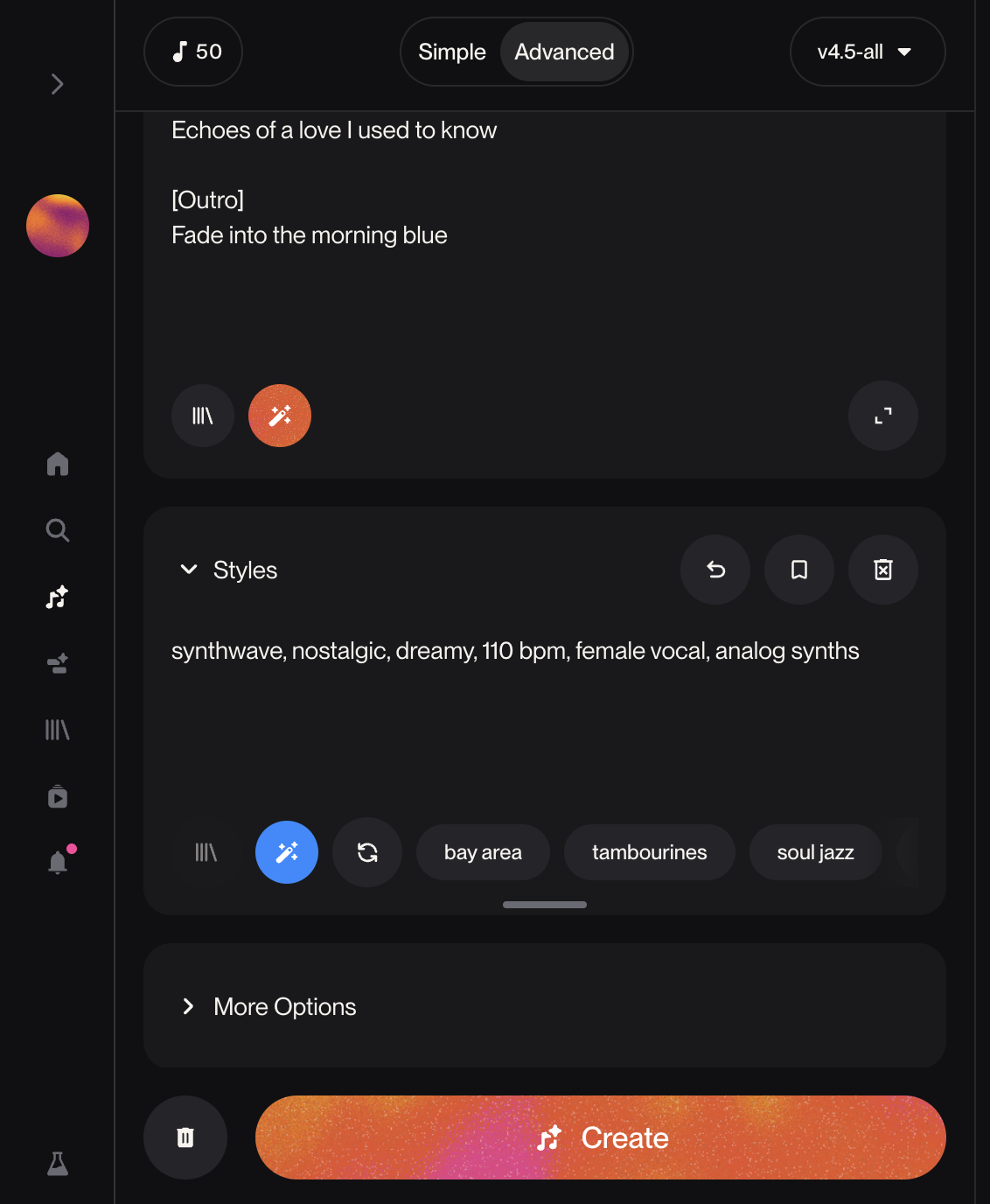
The single word you drop into Suno's Style of Music field decides the whole direction of the track. Type "pop" and the result is one thing; type "synthwave 80s retro" and BPM, instrumentation, vocal timbre, and mix color all shift. Same lyric, different descriptor, and the output can differ by 30% or more.
A genre descriptor isn't a tag — it's a meta-instruction. Suno's model infers BPM range, lead instruments, vocal treatment, and mix tone from that descriptor simultaneously. Write lo-fi hip hop and the model automatically pulls in BPM 70 to 85, warm electric piano, vinyl noise, and gentle vocal compression without you typing a single one of those details. The output stays consistent across generations because the descriptor already carries that bundle.
The catch is that some descriptors resolve well and some don't. A niche compound like neoclassical darkwave rarely appears in the model's training data, so results swing wildly. Standard genre names like synthwave, trap, or bossa nova almost always produce a consistent tone. This guide catalogs 87 descriptors that resolve reliably in Suno, organized into five categories.
In my own workflow this gap is obvious the moment I start swapping descriptors. With a compound neologism the tone lurches around from one generation to the next on the same prompt, and picking a best take gets hard; narrow it to a single standard genre name and the outputs converge in one direction instead. So rather than spin my wheels on a niche compound, I now tend to start from a standard genre and tighten it with mood and instrument keywords.
5 main genres + their reliable sub-genres
Start with the five most stable main genres and the sub-genres that consistently get pulled in alongside them. The main genre alone produces a usable result, but adding a sub-genre tightens the tone.
Pop family (12)
pop— the most universal baseline. BPM 100 to 120, clean vocal, standard band arrangementsynth pop— 80s synth bass, BPM 110 to 125k-pop— pairs well with Korean lyrics, fast BPM 120 to 135, lots of beat switchesj-pop— brighter tone overall, more acoustic elementsdream pop— heavy reverb, hazy vocals, BPM 80 to 100hyperpop— digital distortion, pitched-up vocals, BPM 140+indie pop— acoustic guitar plus simple drums, BPM 95 to 115electropop— synth leads plus EDM drums, BPM 120 to 128bedroom pop— lo-fi tone, small-mic feel, BPM 80 to 100art pop— unconventional structure, experimental sound designdance pop— 4-on-the-floor kick, strong hooks, BPM 120 to 128power pop— electric-guitar-driven, 80s rock influence
Rock family (10)
rock— electric guitar plus drums as the defaultindie rock— rougher tone, live feelalternative rock— 90s influence, moderate distortionhard rock— heavy distortion, hard-hitting drumspunk rock— fast BPM 150 to 180, short song formspop punk— fast BPM plus melodic vocalsgarage rock— raw recording tone, simple progressionsprogressive rock— long-form, odd metersclassic rock— 70s tone, organ plus electric guitarshoegaze— wall-of-guitar, vocals buried in the mix
Hip-Hop / R&B family (10)
hip hop— standard trap drums, BPM 70 to 90trap— 808 bass forward, hi-hat tripletslo-fi hip hop— warm EP, vinyl noise, BPM 70 to 85boom bap— 90s sampling tone, swung drumsdrill— fast hi-hats, dark tone, BPM 140 to 150cloud rap— synth pads everywhere, hazy vocalsr&b— smooth vocals, 7th chords, BPM 70 to 90neo soul— acoustic plus Rhodes, jazz influencecontemporary r&b— modern pop-leaning R&Balternative r&b— experimental R&B, FKA twigs territory
Electronic family (15)
house— 4-on-the-floor, BPM 120 to 128deep house— darker bass, BPM 120 to 124tech house— minimal synths, BPM 122 to 128techno— driving kick, BPM 125 to 135trance— build-and-drop structure, BPM 130 to 138dnbordrum and bass— fast breakbeats, BPM 170 to 180dubstep— wobble bass, BPM 140 (half-time 70)future bass— supersaw chords plus sidechain, BPM 140 to 160synthwave— 80s synths plus gated reverb snare, BPM 80 to 110vaporwave— slow BPM 60 to 80, pitched down, 8-bit noisechillwave— warm synth pads, BPM 80 to 100ambient— no fixed rhythm, synth dronesidm— experimental beats, glitch soundsbreakbeat— 90s influence, BPM 130 to 140hardstyle— heavily distorted kick, BPM 150
Jazz / acoustic family (8)
jazz— standard combo, walking bassbossa nova— bossa guitar pattern, soft vocals, BPM 70 to 90lounge— 70s influence, vibraphoneswing— 4-beat swing drums, big-band hornsbebop— fast BPM 200+, complex harmonyacoustic folk— acoustic guitar plus vocals, simple structureindie folk— acoustic with a touch of electriccountry— country guitar plus pedal steel
That's 55 descriptors. Knowing the five main families is enough to find a starting point for almost any track. Pick the family closest to what you're after, add one sub-genre, and you've got a safe launch position.
Instrument descriptors — "live drums" vs "808 trap drums"
A genre descriptor pulls instrumentation along with it, but when you want to push a specific instrument into the foreground, add a dedicated descriptor. Fourteen instrument keywords that resolve well in Suno:
live drums— acoustic drum kit, natural room tone808 drumsor808 trap drums— heavy sub-bass kickacoustic guitar— steel-string acousticnylon guitar— classical guitar, pairs with bossa nova and flamencoelectric guitar— electric guitar (tone follows the genre)distorted guitar— distortion for rock and metalpiano— acoustic grandelectric pianoorrhodes— 70s Fender Rhodes tonesynth bass— synthetic bass for electronic genresupright bass— walking bass for jazzstrings— string section for ballads and cinematic workbrass— brass section for funk and jazzsaxophone— sax solovinyl noise— lo-fi noise floor, vintage tone
Stick to about two instrument descriptors. synthwave with saxophone — genre plus one instrument — resolves cleanly. Stretch it to synthwave with saxophone, electric guitar, piano, strings, choir and the model loses priority, with results swinging unpredictably.
Write instrument names in English. saxophone resolves better than 색소폰, because most of Suno's training metadata is in English.
Mood and energy keywords — slow / uptempo / dreamy / aggressive
Mood keywords shift BPM and vocal treatment. Genre plus mood is one of the most reliable combinations in the entire system.
slow— pulls BPM down one step (pop 100 → slow pop 80)uptempo— pushes BPM up one stepdreamy— more reverb, hazy vocals, heavier pad usageenergetic— harder drums, faster BPMaggressive— more distortion, bigger dynamicsmelancholic— minor key, slower BPMuplifting— major key, bright harmonynostalgic— vintage tone, soft reverbcinematic— string section, full dynamic rangeintimate— small arrangement, close-mic toneepic— large arrangement, big dynamics, build-upschill— slow BPM, soft tonedark— minor key, dark synths, low-end weightbright— major key, top-end emphasis, bright synths
A combo like synthwave nostalgic dreamy nails the tone. Stop at two or three mood keywords. Past four, they start contradicting each other and the result blurs.
Era and region descriptors — 80s synthwave, lo-fi Korean indie
Era and region descriptors are surprisingly strong in Suno. Writing synthwave produces one tone; writing 80s synthwave adds gated reverb snare, DX7 synth timbre, and analog chorus on top.
Eight era descriptors:
60s— mono tone, vintage reverb, simple drums70s— analog synths arrive, funk and disco80s— gated reverb, FM synths, synth bass90s— the grunge / house / boom bap era2000s— digital tone forward, R&B and emo2010s— EDM, trap, hyperpopretro— undated vintage tonemodern— current mix style, clean sound
Eleven region descriptors that also resolve well:
korean indie— Korean indie tonejapanese city pop— Japanese city pop, 80s Tokyolatin— Latin rhythms, percussionafrobeats— African BPM 100 to 115, polyrhythmbrazilian— bossa nova and samba influenceflamenco— flamenco guitarceltic— Celtic horns, 5/8 meterarabic— maqam scales, oudindianorbollywood— Indian film music tonecaribbean— reggae and soca influencecountry americana— American country
Region descriptors resolve best when stacked with a main genre. korean indie pop is more stable than korean alone, and japanese city pop reproduces the 80s Tokyo tone almost exactly. Stack mood plus region plus genre — like lo-fi korean indie — and the tone narrows dramatically.
Genres that don't resolve well — "neoclassical darkwave" and other niches
Not every label works. These patterns produce inconsistent results:
- Compound neologisms —
neoclassical darkwave,solarpunk,weirdcore— too few training samples - Hyper-narrow micro-genres —
seapunk,witch house,vaporgrunge— SoundCloud-era niches - Regional minor genres —
enkaor노라조, locked to Korea or Japan - Classical sub-classifications —
baroque counterpoint,serialism— academic terms - Over-specific metal sub-genres —
melodic death metal,progressive black metal
Two strategies if you need a niche sound. First, decompose it into a nearby standard genre plus modifier keywords. darkwave becomes synthwave dark cold 80s and lands fairly close. Second, lift the keywords directly from a reference track. Suno's training data uses standard Spotify and Apple Music genre labels, so the official label of a reference track is usually the safest starting word.
To avoid burning credits on a label the model doesn't know, generate once. If the result feels random, fall back to a standard genre. If you've run the same niche descriptor five times and the output still doesn't converge, the model doesn't have a clear concept for that word.
Combination rules — 2 is fine, 4 is dead
You can stack genres, but only so far. The pattern that holds:
- 1 genre — most stable. Tone resolves cleanly
- 2 genres — fine if they're close (
synth pop electropop) or an established fusion (jazz hip hop) - 3 genres — one or two get ignored. Priority becomes murky
- 4+ genres — output approaches random
A safe upper bound: 1 genre + 1 sub-genre + 2 moods + 1 era + 1 instrument. Keep the total under 7 descriptors.
The most common mistake when combining is pairing genres that fight each other. country techno mixes incompatible BPMs, instrumentation, and culture — the model picks one and drops the other. Stack genres that already live near each other: country folk, techno house.
When the sound you want is a fusion without a standard label, anchor on the nearest standard genre and let mood, era, and instrument descriptors do the narrowing. synth pop nostalgic 80s with saxophone resolves far more reliably than synthwave city pop 80s yacht rock.
Quick reference catalog
All 87 descriptors collected by category. Main genres 55, instruments 14, moods 14, eras 8, regions 11 — that's 102 raw entries, but stripping duplicates and sub-categories leaves the 87 core descriptors that cover almost any track.
| Category | Reliable descriptors |
|---|---|
| Pop | pop, synth pop, k-pop, j-pop, dream pop, hyperpop, indie pop, electropop, bedroom pop, dance pop |
| Rock | rock, indie rock, alternative rock, hard rock, punk rock, pop punk, classic rock, shoegaze |
| Hip-Hop / R&B | hip hop, trap, lo-fi hip hop, boom bap, drill, r&b, neo soul, alternative r&b |
| Electronic | house, deep house, techno, trance, dnb, dubstep, future bass, synthwave, vaporwave, chillwave, ambient |
| Jazz / acoustic | jazz, bossa nova, swing, acoustic folk, indie folk, country |
| Instruments | live drums, 808 drums, acoustic guitar, electric guitar, piano, rhodes, synth bass, strings, brass, saxophone |
| Moods | slow, uptempo, dreamy, energetic, melancholic, uplifting, nostalgic, cinematic, chill, dark, bright |
| Eras | 60s, 70s, 80s, 90s, 2000s, retro, modern |
| Regions | korean indie, japanese city pop, latin, afrobeats, brazilian, flamenco, celtic, americana |
Scan this table once and descriptor selection drops to under a minute. "A mellow K-pop track with 80s vibes" becomes k-pop 80s nostalgic dreamy — four keywords, done. Generate that combination 3 to 5 times with the same lyric and pick the best take.
Combining descriptors only does its job when you're the one typing them. A track you synthesized from k-pop 80s nostalgic dreamy is your own prompted output, and using it for personal listening, DAW post-processing, or your portfolio is well within bounds. Suno Pro subscribers also have a clear right to keep lossless WAV backups of the songs they generate themselves. Pulling another creator's track, claiming the same descriptors got you there, and redistributing or commercializing it is a different conversation that needs a separate agreement. The catalog is a map for narrowing your own tone, not a license for someone else's work.
The full lyrics-prompting workflow lives in Suno AI Lyrics Prompting. Once the descriptors are locked, the next step is DAW post-processing — Post-Processing Suno Tracks in a DAW covers the EQ, compression, and mastering checklist. When the track is finished, SunoDown downloads the whole playlist in lossless WAV or MP3 in one click.
Ready to try it?
Open SunoDown →